







Introduction
Most self-care advice is written for people with time. Long morning routines. Hour-long yoga sessions. Elaborate meal prep Sundays. For the majority of working adults, that advice isn’t just unhelpful — it’s demoralising.
Burnout among professionals hit record levels in 2024 and hasn’t recovered. The pressure to stay productive, connected, and performing while managing personal responsibilities has created a chronic stress baseline that most people treat as normal. It isn’t.
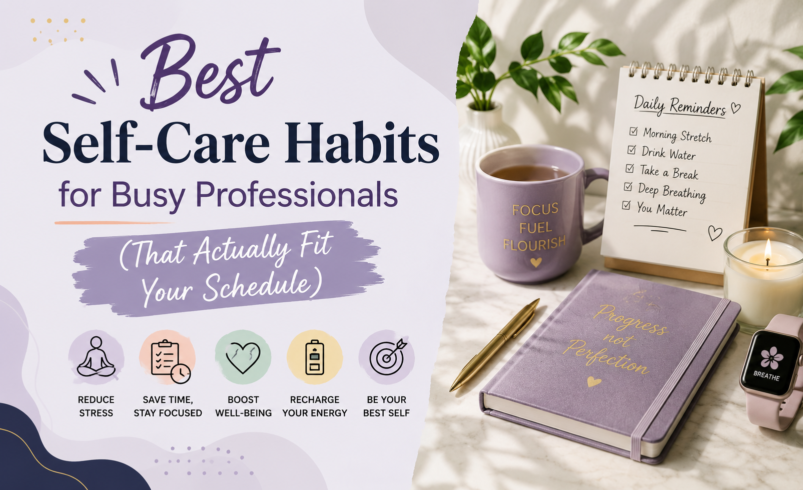
This guide focuses on the best self-care habits for busy professionals — realistic, evidence-backed, and designed for people whose schedules are already full. No two-hour morning routines. No expensive retreats. Just practical wellness habits that prevent burnout and actually work.
People find waiting more tolerable when they can see the work being done on their behalf
“Labor Illusion” insight
Table of Contents
- Why Self-Care Matters for Busy Professionals
- Best Daily Self-Care Habits
- Time-Efficient Self-Care Strategies
- Technology & Wellness Tools Comparison
- Self-Care Approaches: Comparison Table
- Mental Wellness & Burnout Prevention
- Self-Care Habits by Profession
- FAQ
- Conclusion
1. Why Self-Care Matters for Busy Professionals
Skipping self-care doesn’t create more time. It borrows against future capacity — focus, patience, creativity, and resilience — and eventually the debt comes due.
The Cost of Chronic Stress
Chronic workplace stress is associated with a 45% higher risk of cardiovascular disease, measurably impaired cognitive function, and significantly reduced decision-making quality. These aren’t edge-case outcomes. They’re the documented baseline of sustained high-stress professional life without adequate recovery.
The irony: professionals who neglect self-care in the name of productivity consistently produce worse work than those who protect recovery time. The research on this is unambiguous.
Productivity vs Burnout
Burnout doesn’t arrive suddenly. It accumulates through depleted sleep, skipped meals, zero downtime, and sustained cortisol elevation — until the system stops performing at baseline. At that point, even simple tasks feel overwhelming.
Prevention is exponentially cheaper than recovery. A daily 20-minute walk and a consistent sleep schedule are more protective against burnout than most corporate wellness programmes combined.
Self-care for professionals isn’t a luxury. It’s maintenance. Skipping it is like skipping oil changes and being surprised when the engine fails.
2. Best Daily Self-Care Habits for Busy Professionals
These are the most evidence-backed, time-efficient daily self-care ideas for productivity and balance — ranked by impact-to-effort ratio.
Morning Routine (Even a Short One)
A realistic morning routine for a busy professional doesn’t need to be elaborate. It needs to be consistent. The goal is 10–15 minutes that belong to you before the workday demands begin.
- Fixed wake time — the most impactful sleep lever available, completely free
- No phone for the first 20 minutes — sets a reactive vs intentional tone for the whole day
- Water before caffeine — dehydration after sleep impairs cognitive function within minutes
- One clear intention — not a full to-do list, just one anchoring priority
Hydration
Mild dehydration (as little as 1–2% of body weight) measurably impairs attention, memory, and mood. Most professionals are chronically mildly dehydrated. The fix is structural, not motivational: keep a water bottle at your desk and treat 250ml per hour as a non-negotiable work input.
Mindful Breaks During Work
The Pomodoro technique — 25 minutes of focused work, 5-minute break — has strong research support for both cognitive performance and stress reduction. The break needs to be an actual break: stand up, move, look away from screens.
- 2-minute breathing exercise before high-stakes calls (reduces cortisol measurably)
- 5-minute walk at lunch — even a building corridor loop counts
- Eyes off screen every 20 minutes — the 20-20-20 rule (look at something 20 feet away for 20 seconds) reduces eye strain and cognitive fatigue
Sleep Optimisation
Sleep is the highest-ROI wellness habit available to any professional. Consistent sub-7-hour sleep impairs performance at the level of clinical intoxication — yet most professionals treat it as the first thing to sacrifice.
- Consistent sleep and wake times, including weekends
- No screens 45 minutes before bed — blue light delays melatonin by up to 90 minutes
- Bedroom temperature below 19°C / 66°F — core temperature drop triggers sleep onset
- No work email after a fixed cut-off time — work rumination is a primary driver of poor sleep quality
Digital Detox Routines
Constant connectivity is the defining stressor of modern professional life. A structured digital detox doesn’t mean going offline — it means choosing when you’re accessible rather than being permanently reactive.
- Notifications off for all non-urgent apps during focused work blocks
- Email checked at fixed times rather than continuously
- Social media time-boxed to 20–30 minutes maximum
- One screen-free hour before sleep — non-negotiable for sleep quality
Journaling
Ten minutes of free writing before sleep reduces next-day anxiety by clearing cognitive load — the mental equivalent of closing browser tabs. It doesn’t need structure. It just needs to happen.
3. Time-Efficient Self-Care: When You Have No Time
Simple wellness routines for busy lifestyles work because they eliminate the friction of starting. These are self-care habits without wasting time — designed to fit inside an existing schedule, not require a new one.
5-Minute Wellness Habits
- Box breathing: 4 seconds in, 4 hold, 4 out, 4 hold — one cycle takes 16 seconds. Five minutes resets a stress response
- Gratitude log: three things, written by hand, takes under 3 minutes — shown to improve baseline mood over 4+ weeks
- Cold water face rinse: activates the dive reflex, reduces heart rate, immediate alertness reset
- One-minute body scan: sit, close eyes, notice where you’re holding tension — releases it through awareness alone
Self-Care During Work Hours
The most sustainable self-care routines for working adults are embedded in the workday, not added on top of it.
- Stand and move during phone calls — removes sedentary time without adding any
- Eat lunch away from your desk — 20 minutes of genuine break is more restorative than 45 minutes eating while working
- Block 30 minutes of deep work time daily with no meetings — protects cognitive resources
- End each day with a 3-minute shutdown ritual: close tabs, write tomorrow’s top priority, close the laptop
4. Technology & Wellness Tools Comparison
The right digital wellness tool reduces friction for good habits. The wrong one adds complexity and becomes another thing to manage. Here’s an honest comparison:
|
Tool |
Best For |
Free Plan? |
Cost (Paid) |
Stress Reduction |
Key Strength |
|
Calm |
Sleep + relaxation |
Limited |
$69.99/yr |
High |
Sleep Stories, daily calm |
|
Headspace |
Structured meditation |
Limited |
$69.99/yr |
High |
Beginner-friendly courses |
|
Insight Timer |
Free meditation library |
Yes |
$59.99/yr |
High |
Largest free content base |
|
Notion |
Wellness journaling |
Yes |
$10/mo |
Medium |
Fully customisable |
|
Fabulous |
Habit building |
Limited |
$49.99/yr |
Medium |
Science-based routines |
|
Apple Watch |
Passive health tracking |
N/A (hardware) |
$399+ |
Medium |
Seamless, always-on data |
Recommendation: Pick one meditation app and one habit tracker — that’s sufficient. Multiple apps doing the same job creates cognitive overhead rather than wellness benefit. Calm or Headspace for meditation, Fabulous or a simple Notion template for habits. Use consistently for 30 days before evaluating.
5. Self-Care Approaches: Full Comparison
Not all self-care approaches deliver equal value for busy professionals. Here’s a practical breakdown:
|
Approach |
Time Needed |
Cost |
Sustainability |
Effectiveness |
Best For |
|
Practical daily micro-habits |
5–20 min |
Free |
Very High |
High |
Everyone |
|
Luxury self-care (spa, retreats) |
Hours |
₹3,000–₹30,000+ |
Low |
Medium |
Occasional reset |
|
Morning routine only |
20–45 min |
Free–Low |
High |
High |
Early risers |
|
Evening routine only |
20–30 min |
Free–Low |
High |
High |
Night owls |
|
Digital wellness tools only |
10–15 min |
Free–$10/mo |
Medium |
Medium |
Tech-forward users |
|
Offline / analog routines |
10–30 min |
Free |
Very High |
High |
Screen-fatigued users |
The consistent finding: free, daily micro-habits outperform expensive or time-intensive interventions for long-term stress management and burnout prevention. Luxury self-care has a place as an occasional reset — but it’s no substitute for daily sustainable habits.
6. Mental Wellness & Burnout Prevention
Setting Boundaries with Work
The most underrated burnout prevention habit for professionals is also the least glamorous: a fixed end-of-work time that is actually enforced. Boundaries aren’t a soft skill — they’re a cognitive resource management strategy.
Work expands to fill available time. A fixed boundary forces prioritisation and protects recovery. Without it, the nervous system never fully disengages — and chronic activation leads directly to burnout.
- Communicate availability hours clearly to colleagues
- Remove work email from your personal phone — or turn off push notifications permanently
- Protect at least one full day per week with no work inputs
Social Media Overstimulation
Social media consumption activates the same stress pathways as actual threats — particularly doomscrolling news and comparison-based platforms. For professionals already operating at high cognitive load, it compounds rather than relieves stress.
A structured approach: audit which platforms actually add value vs which are habitual, and delete the habit-based ones from your phone. Keeping them on desktop only reduces passive consumption by 60–70% for most people.
Work-Life Balance Habits That Actually Work
- Protect your commute as personal time — audiobooks, music, or silence (not work calls)
- Schedule personal activities with the same formality as work meetings
- Build one non-work interest that requires your full attention — a genuine cognitive reset
- Prioritise social connection: strong relationships are one of the most protective factors against burnout and the most commonly sacrificed
7. Self-Care Habits by Profession
Different working contexts create different burnout patterns. Here’s what the evidence and practical experience suggest for each:
|
Profession |
Top Burnout Risk |
Priority Habit |
Key Tool |
Quick Win |
|
Remote Worker |
Isolation + no boundaries |
Fixed shutdown time |
Notion tracker |
Walk after work hours |
|
Entrepreneur |
Always-on mentality |
Weekly full rest day |
Calm / Headspace |
Phone-free morning |
|
Corporate Professional |
Meeting overload |
Midday movement break |
Smartwatch reminders |
2-min breathing before calls |
|
Freelancer |
Income anxiety + no routine |
Consistent wake time |
Habit app (Fabulous) |
Daily journaling |
8. FAQ — People Also Ask
What are the best self-care habits for busy professionals?
The highest-impact, lowest-time habits are: consistent sleep and wake times, no phone for the first 20 minutes of the day, a 5-minute breathing or movement break between work blocks, and a fixed end-of-work time. These four changes — all free, all under 20 minutes combined — cover the core of stress management and burnout prevention for working adults.
How do busy people practice self-care?
By embedding it into existing routines rather than adding it on top. Stand during phone calls. Take an actual lunch break. Drink water at your desk. End each workday with a 3-minute shutdown ritual. The most effective self-care routines for working adults don’t require extra time — they require using existing time better.
What are realistic wellness habits for working adults?
Realistic means consistent and frictionless: a fixed wake time, hydration at your desk, one 5-minute break per work block, journaling before sleep, and protecting one full day per week without work. These aren’t dramatic — but executed consistently over 30 days, they produce measurable improvements in energy, focus, and stress baseline.
Can self-care improve productivity and mental health?
Yes — and the research is clear. Adequate sleep improves decision-making, creativity, and emotional regulation. Regular movement increases BDNF, a brain-derived protein directly linked to cognitive performance. Stress management practices reduce cortisol, which when chronically elevated impairs memory and executive function. Self-care isn’t in conflict with professional performance. It’s the physiological foundation of it.
9. Conclusion
The best self-care habits for busy professionals aren’t the most elaborate ones — they’re the ones you’ll actually do, consistently, without requiring ideal conditions.
Start with three: a fixed wake time, one real break during your workday, and a clear end-of-work boundary. These alone will outperform most wellness programmes within a month.
Sustainable self-care isn’t about perfection. It’s about showing up for yourself with the same reliability you show up for everything else. You can’t perform at your best on a depleted system — and no amount of ambition changes that.
Protect your recovery. It’s the most professional thing you can do.