




Last Updated: May 2026 | ✓ Independently researched | ✓ Real pricing verified | ✓ No sponsored rankings
If you are running a small business and still managing customer relationships in a spreadsheet — or worse, from memory — you are leaving money on the table every single day.
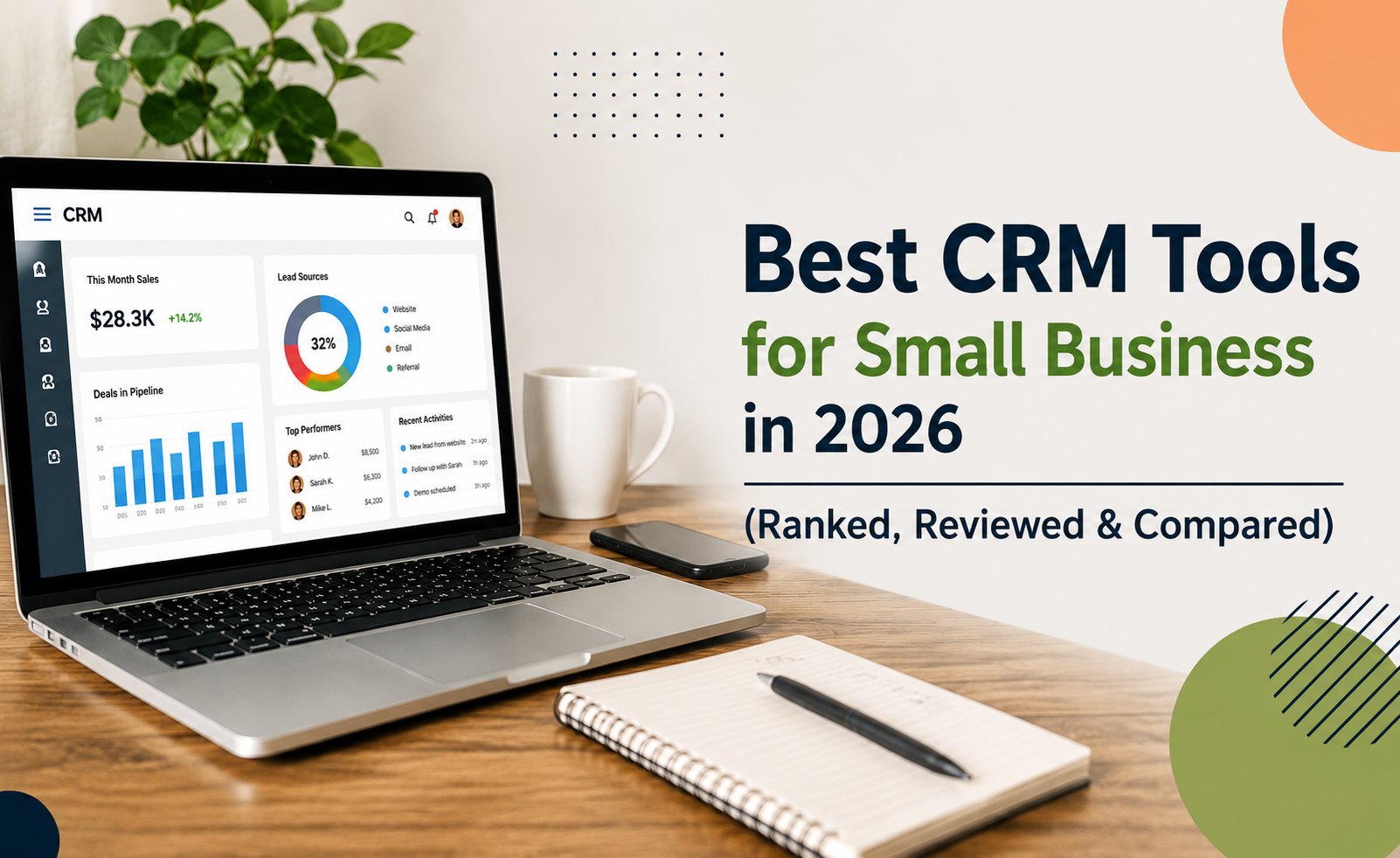
The right CRM (Customer Relationship Management) software for a small business in 2026 does not just store contacts. It automates follow-ups, scores leads with AI, syncs your email marketing, tracks every deal in your pipeline, and tells you exactly where revenue is slipping through the cracks.
People find waiting more tolerable when they can see the work being done on their behalf
“Labor Illusion” insight
The problem? With over 800 CRM tools now available on the market, choosing the right one feels paralyzing. Most comparison guides are written by vendors with affiliate commissions. This one is not.
This guide breaks down the 10 best CRM tools for small businesses in 2026 — rigorously compared on pricing, AI capabilities, ease of use, automation depth, integrations, and scalability. Whether you are a solo founder, a 10-person sales team, an ecommerce brand, or a service business, you will find the right recommendation below.
What you will learn: – Which CRM tools offer the best value for small businesses on a budget – How AI is changing CRM software in 2026 and which tools lead – Hidden costs most small businesses discover too late – A decision framework to pick the right CRM in under 10 minutes – FAQs targeting the most common search questions
Table of Contents
- What Makes a Great Small Business CRM in 2026?
- Quick Comparison Table — All 10 CRMs at a Glance
- The 10 Best CRM Tools for Small Businesses (Full Reviews)
- Best CRM by Use Case — Quick Picks
- CRM Trends Shaping Small Business in 2026
- AI Automation in CRM: What’s Actually Changed
- CRM for Remote Teams
- CRM Integrations: Email Marketing & Ecommerce
- Hidden Costs & Scalability Traps
- CRM Implementation Tips for Small Businesses
- Common Mistakes Small Businesses Make When Choosing a CRM
- Expert Buying Framework: How to Choose the Right CRM
- FAQ Section
- Final Verdict
1. What Makes a Great Small Business CRM in 2026?
Before diving into the tools, it helps to establish clear criteria. A CRM built for a Fortune 500 enterprise is not the same as one built for a 5-person sales team. For small businesses specifically, the best CRM software must score high on these five dimensions:
|
Criterion |
Why It Matters for Small Businesses |
|
Ease of use |
No dedicated IT team. If reps don’t use it, it has zero value. |
|
Pricing transparency |
Hidden fees kill budgets. True cost per user matters. |
|
Automation depth |
Small teams need to do more with fewer people. |
|
Integration ecosystem |
Must connect with tools already in use: Gmail, Shopify, Mailchimp. |
|
Scalability |
Should grow without requiring a platform migration at 20 users. |
Expert Insight: According to research published by G2 in early 2026, the average small business CRM adoption failure rate is 42%. The primary cause is not poor features — it is poor ease of use. The tool your team will actually open every morning beats the tool with every feature on paper.
2. Quick Comparison Table — All 10 CRMs at a Glance
|
CRM Tool |
Starting Price |
Free Plan |
Best For |
AI Features |
Ease of Use (1–10) |
G2 Rating |
|
HubSpot |
Free / $20/mo |
✓ Unlimited users |
Marketing-led teams |
Moderate |
9/10 |
4.4/5 |
|
Zoho CRM |
$14/user/mo |
✓ Up to 3 users |
Best value overall |
Strong (Zia AI) |
7/10 |
4.1/5 |
|
Salesforce |
$25/user/mo |
✗ |
Enterprise & complex sales |
Best-in-class (Einstein) |
6/10 |
4.4/5 |
|
Pipedrive |
$14/user/mo |
✗ (14-day trial) |
Visual pipeline management |
Moderate |
9/10 |
4.2/5 |
|
Monday CRM |
$15/user/mo |
✓ Basic |
Project + CRM hybrid teams |
Growing |
9/10 |
4.6/5 |
|
Freshsales |
$9/user/mo |
✓ Up to 3 users |
AI-led sales scoring |
Strong (Freddy AI) |
8/10 |
4.5/5 |
|
Keap |
$249/mo flat |
✗ |
Solopreneurs + automation |
Basic |
7/10 |
4.2/5 |
|
Close CRM |
$49/user/mo |
✗ (14-day trial) |
Inside sales + calling |
Moderate |
8/10 |
4.7/5 |
|
Nimble |
$24.90/user/mo |
✗ |
Social selling + SMBs |
Basic |
8/10 |
4.4/5 |
|
Insightly |
$29/user/mo |
✓ Up to 2 users |
Service businesses + projects |
Moderate |
7/10 |
4.2/5 |
3. The 10 Best CRM Tools for Small Businesses (Full Reviews)
HubSpot CRM — Best Free CRM for Small Businesses
Best for: Marketing-led startups, early-stage businesses, teams new to CRM Starting price: Free forever / Starter at $20/month
HubSpot CRM remains the most accessible entry point for small businesses in 2026. The free plan includes unlimited users, unlimited contacts, deal tracking, email integration, live chat, and a basic reporting dashboard — features that most competitors charge for. Most small businesses operate on the free tier for 12 to 24 months before outgrowing it.
What makes HubSpot stand out: – Best-in-class onboarding experience. New users can build a functional pipeline in under an hour. – Deep integration with HubSpot’s Marketing, Service, and Operations Hubs creates a unified customer data platform. – Over 1,500 native app integrations including Gmail, Outlook, Shopify, WordPress, Slack, and Zoom. – HubSpot Academy offers free certifications — a genuine competitive moat for team training.
Where HubSpot falls short: – The pricing cliff from Starter ($20/month) to Professional ($800/month flat) is one of the steepest in the industry. Serious automation requires Professional. – AI features on lower tiers are basic. Predictive lead scoring and advanced AI are locked behind expensive plans. – API call limits on free and Starter plans can become a headache for developer-heavy teams.
Pricing breakdown: | Plan | Price | Key Features | |—|—|—| | Free | $0 (unlimited users) | Contact management, deal pipeline, email tracking, forms | | Starter | $20/month total | Ad management, simple automation, removing HubSpot branding | | Professional | $800/month flat | Full workflow automation, custom reporting, AI content tools | | Enterprise | $3,600/month flat | Advanced AI, custom objects, predictive scoring |
Verdict: HubSpot is the #1 recommendation for small businesses that need a free, full-featured starting point and a clean upgrade path into marketing automation. Just know the pricing math before assuming you’ll stay affordable at scale.
Zoho CRM — Best Value CRM for Small Business in 2026
Best for: Cost-conscious teams (5–50 people), businesses wanting an all-in-one app ecosystem Starting price: $14/user/month (Standard)
Zoho CRM is the most underrated CRM for small businesses in 2026. At $14/user/month on Standard and $23/user/month on Professional, it delivers workflow automation, custom modules, real-time activity tracking, and Blueprint (a visual process builder) at a fraction of HubSpot Professional or Salesforce’s price.
The Zoho One advantage:
For $37/user/month, Zoho One unlocks the entire Zoho ecosystem: Zoho Books (accounting), Zoho Desk (customer support), Zoho Campaigns (email marketing), Zoho Projects, and 45+ additional applications. For small businesses already paying for QuickBooks, Mailchimp, and a support tool separately, Zoho One alone can reduce the software stack cost by 40–60%.
What makes Zoho CRM stand out: – Zia AI: Zoho’s built-in AI assistant auto-updates records, recommends workflows, detects pipeline anomalies, and provides lead scoring — available at the Enterprise tier ($40/user/month). – Exceptional customization. Custom fields, custom views, conditional flows, and multi-currency support make it ideal for international businesses. – Strong mobile app with offline access — important for field sales teams. – Omnichannel communication dashboard (email, phone, SMS, social) in one view.
Where Zoho CRM falls short: – The interface, while improved significantly, still feels denser than HubSpot or Pipedrive. – Setup time is longer. The depth of customization that makes Zoho powerful requires initial configuration investment. – Finding Zoho-certified developers is harder than Salesforce or HubSpot talent.
Pricing breakdown: | Plan | Price/User/Mo | Key Features | |—|—|—| | Free | $0 (up to 3 users) | Basic contacts, deals, tasks | | Standard | $14 | Custom fields, scoring rules, workflows | | Professional | $23 | Blueprint, SalesSignals, inventory | | Enterprise | $40 | Zia AI, custom modules, territories | | Ultimate | $52 | Enhanced storage, developer sandbox |
Verdict: Zoho CRM is the best value CRM for small businesses in 2026, full stop. If budget is a primary constraint and you want genuine automation depth, nothing beats the Zoho Professional tier at $23/user/month.
Salesforce Sales Cloud — Most Powerful CRM (But at a Cost)
Best for: Growing businesses with complex multi-stage sales processes, companies planning to scale to 50+ users Starting price: $25/user/month (Starter, max 10 users) / $80/user/month (Professional)
Salesforce invented the cloud CRM category in 1999 and still sets the benchmark for enterprise-grade power. Its AI engine, Einstein and the newer Agentforce, provides predictive lead scoring, revenue forecasting, and autonomous sales agent capabilities that no competitor fully matches in 2026.
However, Salesforce is frequently the wrong choice for small businesses. A realistic all-in deployment for a 10-person sales team — including implementation, add-ons, and admin costs — runs $150 to $250/user/month. For a 10-person team, that’s $1,500 to $2,500/month minimum.
Real-world perspective (sourced from user research): “Salesforce has a super robust offering, but it’s not well equipped to satisfy a small team. It’s way too overpowered and overpriced for what we need.” — Stephen Sexton, Director of Partnerships, NowADays Media (2026)
Where Salesforce earns its reputation: – Agentforce autonomous AI agents can conduct prospecting research, summarize calls, and schedule follow-ups without human input. – AppExchange marketplace: 7,000+ integrations — the largest ecosystem in CRM. – Trailhead learning platform offers one of the best free training ecosystems in B2B software. – Industry-specific Clouds (Healthcare Cloud, Financial Services Cloud, Manufacturing Cloud) add specialized workflow logic.
Pricing breakdown: | Plan | Price/User/Mo | Notes | |—|—|—| | Starter Suite | $25 | Max 10 users, limited features | | Professional | $80 | Full customization, API access | | Enterprise | $165 | Advanced automation, developer tools | | Unlimited | $330 | Premier support, unlimited sandboxes |
Verdict: Choose Salesforce only if you have complex sales processes, a dedicated CRM admin, and a realistic budget over $100/user/month all-in. For most small businesses with under 25 team members, HubSpot Professional or Zoho Enterprise deliver 80% of Salesforce’s capability at 20% of the cost.
Pipedrive — Best CRM for Visual Sales Pipeline Management
Best for: Sales teams that live in their pipeline, B2B businesses with defined deal stages Starting price: $14/user/month (Essential)
Pipedrive is built by salespeople for salespeople. Its drag-and-drop visual pipeline is the cleanest and most intuitive in the industry. The philosophy is activity-based selling: instead of overloading reps with data, Pipedrive asks one question — “what is the next action on this deal?”
What makes Pipedrive stand out: – Setup in hours, not weeks. A small sales team can be operational within a single afternoon. – Smart email BCC automatically logs all email activity to the correct deal — no manual data entry. – AI Sales Assistant (available on all paid plans) flags stale deals, suggests activity prioritization, and identifies deals at risk. – Strong mobile app with business card scanning and offline sync. – Built-in calling and SMS (via add-ons) without third-party tools.
Where Pipedrive falls short: – No native email marketing. You’ll need a separate tool like Mailchimp or ActiveCampaign. – No free plan (14-day trial only). – Marketing and customer service features are limited compared to HubSpot or Zoho. – Reporting becomes more powerful at higher tiers — the Essential plan is genuinely limited on analytics.
Pricing breakdown: | Plan | Price/User/Mo | Key Features | |—|—|—| | Essential | $14 | Pipelines, contacts, AI assistant | | Advanced | $29 | Full email sync, automation builder, scheduling | | Professional | $59 | AI-powered deal scoring, revenue forecasting, e-signatures | | Power | $69 | Phone contracts, implementation support | | Enterprise | $99 | Unlimited customization, audit logs, dedicated support |
Verdict: Pipedrive is the best pure-play sales CRM for small businesses that want fast onboarding, intuitive pipeline management, and immediate productivity gains. If your primary goal is closing more deals (not marketing automation), start here.
Monday CRM — Best for Teams That Also Manage Projects
Best for: Teams blending sales, operations, and project delivery; agencies; creative businesses Starting price: $15/user/month (Basic, minimum 3 users)
Monday CRM sits at the intersection of project management and CRM, making it uniquely suited for businesses where the same team that sells a project also delivers it. Built on the Monday.com Work OS platform, it inherits that platform’s visual flexibility and collaboration strengths.
What makes Monday CRM stand out: – Highly customizable no-code boards. Teams can build exactly the view they need. – Strong collaboration features: @mentions, file attachments, real-time updates, and timeline views built in. – Native integrations with Zoom, Slack, Gmail, and 200+ tools. – Monday AI (launched 2025, enhanced 2026) can generate email drafts, summarize meeting notes, and flag at-risk accounts. – Generous free plan with up to 2 seats, useful for true solopreneurs.
Where Monday CRM falls short: – As a CRM specifically, it lacks depth in sales automation and lead scoring compared to Zoho, HubSpot, or Salesforce. – Minimum 3 seats on paid plans makes it slightly more expensive for 1–2 person teams. – Reporting is strong visually but less powerful for revenue analytics than dedicated CRMs.
Verdict: Monday CRM is the top choice for service businesses, agencies, or teams where sales and delivery overlap. It won’t replace a dedicated sales CRM for high-volume deal teams, but for the SMBs that need “one tool for everything,” it is the closest thing available in 2026.
Freshsales — Best AI-Powered CRM for Small Business
Best for: Growing sales teams wanting AI automation without Salesforce pricing Starting price: $9/user/month (Growth)
Freshsales (part of Freshworks) has made the biggest leap in AI capability among mid-market CRMs in 2025–2026. Its Freddy AI assistant provides contact scoring, deal health monitoring, next-best-action recommendations, and conversation intelligence — all available from the Pro plan at $39/user/month.
What makes Freshsales stand out: – Freddy AI provides genuinely useful lead scoring out of the box, without the data engineering overhead Salesforce Einstein requires. – Built-in phone, SMS, WhatsApp, and live chat — Freshsales is a true multi-channel engagement platform. – Strong free plan: up to 3 users with basic contact management, deal pipeline, and email. – Native integration with Freshdesk (support) and Freshmarketer (marketing automation) creates a full customer lifecycle stack.
Pricing breakdown: | Plan | Price/User/Mo | Key Features | |—|—|—| | Free | $0 (up to 3 users) | Contacts, pipeline, basic email | | Growth | $9 | AI deal insights, custom fields, sequences | | Pro | $39 | Freddy AI, sales forecasting, auto-profiles | | Enterprise | $59 | Custom modules, dedicated account manager |
Verdict: Freshsales is the best AI-powered CRM for small businesses that need intelligent automation at an accessible price point. Its $9/user/month Growth plan is one of the most competitively priced entry tiers in 2026.
Keap — Best CRM + Automation for Solopreneurs
Best for: Solopreneurs, solo service providers, coaches, consultants Starting price: $249/month flat (up to 2 users, 1,500 contacts)
Keap (formerly Infusionsoft) combines CRM, marketing automation, sales pipeline, invoicing, and appointment scheduling into a single platform designed for businesses of 1 to 5 people. It is the most complete “all-in-one” tool on this list — and the most opinionated about workflow design.
What makes Keap stand out: – Built-in invoicing, payment collection, and appointment booking eliminates the need for separate tools. – Automation builder allows highly personalized follow-up sequences triggered by specific lead behavior. – Dedicated coaching and onboarding included with all plans — important for non-technical users.
Where Keap falls short: – The flat-rate pricing ($249/month) is expensive for true solopreneurs who only need basic CRM functionality. – The platform has a steeper learning curve than its “simple” marketing suggests. – Contact limits (1,500 on base plan) add costs quickly as your list grows.
Verdict: Keap earns its place for service-based solopreneurs who want their CRM to replace five separate tools. For pure CRM needs, however, HubSpot’s free plan or Pipedrive Essential offer more value at lower cost.
Close CRM — Best CRM for Inside Sales Teams
Best for: High-velocity inside sales teams, SaaS sales, phone-heavy sales environments Starting price: $49/user/month (Startup)
Close CRM is built for one thing: helping inside sales teams make more calls, send more emails, and close more deals — faster than any other platform. Its built-in Power Dialer, Predictive Dialer, and SMS capabilities make it the go-to CRM for teams with high daily outreach volume.
What makes Close CRM stand out: – Native dialing (local presence, call recording, voicemail drop) without third-party integrations. – Sequence automation for multi-touch email + SMS + call cadences. – Pipeline reporting is detailed and sales-focused — built for revenue leaders, not marketers. – G2 rating of 4.7/5 is the highest among all CRMs in this list.
Where Close CRM falls short: – Higher price point ($49/user/month minimum) is a barrier for very early-stage teams. – No free plan. The 14-day trial is the only way to evaluate without payment. – Limited marketing automation — it is a pure sales tool.
Verdict: If your sales model is phone-first, high-volume outreach, Close CRM is the best investment you can make. The built-in calling and sequencing tools alone replace $50–80/user/month in separate software costs.
Nimble CRM — Best CRM for Social Selling
Best for: Consultants, relationship-driven sales, professionals using LinkedIn heavily Starting price: $24.90/user/month
Nimble is the hidden gem of the CRM world for small businesses focused on relationship-driven selling. Its browser extension enriches contact records automatically from LinkedIn, Twitter/X, and company websites — meaning your CRM data stays accurate without manual updates.
What makes Nimble stand out: – Prospector tool auto-builds rich contact profiles from social media and the web. – Unified social inbox aggregates LinkedIn messages, Twitter DMs, and email in one stream. – Simple, clean interface that non-technical users genuinely enjoy. – Strong Microsoft 365 integration makes it ideal for teams standardized on the Microsoft ecosystem.
Verdict: Nimble is the best CRM for consultants, coaches, B2B relationship sellers, and anyone for whom LinkedIn is a primary prospecting channel. It sits in a unique category that no other CRM in this list addresses as well.
Insightly CRM — Best CRM for Service Businesses and Project Delivery
Best for: Professional services firms, agencies, businesses managing client projects post-sale Starting price: $29/user/month (Plus)
Insightly combines CRM with built-in project management, making it uniquely valuable for businesses where the customer relationship continues through delivery. Law firms, consultancies, marketing agencies, and construction companies often find that standard CRMs drop them at the “deal closed” stage — Insightly continues through project completion.
What makes Insightly stand out: – Native project and milestone tracking tied directly to CRM records. – Strong relationship linking — map contacts to organizations, opportunities, and projects simultaneously. – Insightly AppConnect (no-code automation) allows deep workflow automation without developer resources. – Native integrations with QuickBooks, Xero, and G Suite.
Verdict: Insightly is the best CRM for service businesses where selling and delivery happen on the same team. If your CRM needs to live beyond “deal closed,” Insightly is the most purpose-built solution at an accessible price.
4. Best CRM by Use Case — Quick Picks
|
Use Case |
Recommended CRM |
Why |
|
Best CRM for startups |
HubSpot (Free) |
Zero cost to start, scales with the business, best onboarding |
|
Best CRM for ecommerce |
Zoho CRM or HubSpot |
Native Shopify/WooCommerce integrations, cart abandonment workflows |
|
Best CRM for sales teams |
Pipedrive or Close CRM |
Pipeline-first design, activity-based selling, built-in calling |
|
Best affordable CRM |
Zoho CRM Professional ($23/user) |
Enterprise features at SMB pricing |
|
Best AI-powered CRM |
Freshsales (Freddy AI) or Salesforce (Einstein/Agentforce) |
Genuine predictive AI, not just basic automation |
|
Best CRM for service businesses |
Insightly or Monday CRM |
Post-sale project management built into the CRM |
|
Best CRM for solopreneurs |
Keap or HubSpot Free |
All-in-one with invoicing (Keap) or best free starting point (HubSpot) |
|
Best CRM for remote teams |
Monday CRM or HubSpot |
Collaboration features, visual dashboards, timezone-friendly UX |
|
Best CRM for social selling |
Nimble |
LinkedIn enrichment, social inbox, relationship mapping |
|
Best CRM for inside sales |
Close CRM |
Built-in power dialer, sequences, high-velocity outreach tools |
5. CRM Trends Shaping Small Business in 2026
The CRM landscape in 2026 looks materially different from 2023. Here are the five trends every small business decision-maker should understand before selecting a platform.
1. Agentic AI is replacing simple automation
The biggest shift in 2026 CRM is the move from rule-based automation (if X happens, do Y) to agentic AI that can plan multi-step actions, handle objections in email sequences, and update records autonomously. Salesforce Agentforce and HubSpot’s Breeze AI agents are early leaders, but Zoho Zia and Freshsales Freddy are closing the gap rapidly.
2. Conversational AI for data entry
Manual CRM data entry is the #1 reason reps don’t use their CRM. In 2026, voice-to-CRM and meeting transcription tools (via integrations like Gong, Fireflies, and native CRM AI) are eliminating the data entry problem at the source. Close CRM, HubSpot, and Freshsales all offer meeting transcription with automatic record updates.
3. Vertical-specific CRMs are growing
General-purpose CRMs are losing ground to vertical-specific solutions in healthcare, real estate, legal, and construction. Small businesses in these sectors should evaluate purpose-built tools (Clio for legal, Follow Up Boss for real estate) before defaulting to the general market.
4. CRM + payments convergence
Tools like Keap, HubSpot, and Monday CRM are integrating payment collection directly into the CRM workflow. For service businesses, collecting a deposit or invoice at the proposal stage — without switching tools — is a meaningful conversion rate improvement.
5. Privacy and first-party data as competitive advantage
With third-party cookie deprecation now complete, the CRM database is your most valuable marketing asset. Small businesses that have built rich first-party contact profiles (purchase history, interaction data, preference data) are outperforming peers in email marketing conversion rates by 2–3x.
6. AI Automation in CRM: What’s Actually Changed in 2026
Not all “AI” in CRM tools is equal. Here is an honest breakdown of what different AI tiers actually do:
|
AI Capability |
Tools That Offer It |
Value for Small Businesses |
|
Lead/contact scoring |
Salesforce, Freshsales, Zoho (Enterprise), HubSpot Pro |
High — prioritizes rep time on highest-value leads |
|
Deal health monitoring |
Pipedrive AI, Freshsales, Close CRM |
High — flags at-risk deals before they go cold |
|
Meeting transcription + CRM auto-update |
HubSpot, Close, Freshsales |
Very High — eliminates manual data entry |
|
Email generation/AI writing |
HubSpot Breeze, Zoho Zia |
Medium — useful for drafts, not a replacement for personalization |
|
Revenue forecasting AI |
Salesforce Einstein, HubSpot Pro, Zoho |
Medium-High — requires clean historical data to work well |
|
Autonomous AI agents |
Salesforce Agentforce, HubSpot Breeze Agents |
High (enterprise) — currently complex to configure for small teams |
|
Predictive churn scoring |
Salesforce, Freshsales Enterprise |
Medium — more valuable at 200+ customer scale |
The honest take: For most small businesses with 5 to 20 people, the most valuable AI feature in 2026 is meeting transcription with automatic CRM updates. It directly solves the #1 adoption problem (nobody wants to update CRM records manually) and delivers immediate, measurable time savings.
7. CRM for Remote and Distributed Teams
Managing customer relationships across time zones and distributed teams requires different CRM features than a co-located office. Remote-first small businesses should prioritize:
- Real-time activity feeds so teammates can see what happened without a standup call
- @mention and comment threads within deal records (HubSpot, Monday CRM, Insightly)
- Mobile apps with offline sync for sales reps who are traveling or in low-connectivity areas
- Timezone-aware scheduling for follow-up sequences and meeting booking (Pipedrive, HubSpot)
- Video call integrations (Zoom, Google Meet, Microsoft Teams) with automatic logging
Top picks for remote teams: Monday CRM (best collaboration), HubSpot (best overall remote UX), Close CRM (best for distributed inside sales teams with calling).
8. CRM Integrations with Email Marketing and Ecommerce
A CRM that sits in isolation is only half the story. Here is how the top platforms connect to the tools small businesses rely on most:
Email marketing integrations
|
CRM |
Mailchimp |
ActiveCampaign |
Klaviyo |
Built-in Email Marketing |
|
HubSpot |
✓ Native |
✓ Native |
✓ Native |
✓ (HubSpot Campaigns) |
|
Zoho CRM |
✓ Native |
✓ App |
✓ App |
✓ (Zoho Campaigns) |
|
Salesforce |
✓ Native |
✓ Native |
✓ Native |
Partial (Marketing Cloud) |
|
Pipedrive |
✓ Zapier |
✓ Native |
✓ Zapier |
Basic email only |
|
Freshsales |
✓ Native |
✓ App |
✓ Native |
✓ (Freshmarketer) |
Ecommerce integrations
|
CRM |
Shopify |
WooCommerce |
Stripe |
Square |
|
HubSpot |
✓ Native |
✓ Native |
✓ Native |
✓ App |
|
Zoho CRM |
✓ App |
✓ App |
✓ Native |
✓ App |
|
Pipedrive |
✓ Zapier |
✓ Zapier |
✓ Native |
✓ Zapier |
|
Freshsales |
✓ App |
✓ App |
✓ Native |
✓ Zapier |
|
Monday CRM |
✓ Zapier |
✓ App |
✓ Native |
✓ Zapier |
Key recommendation: For ecommerce businesses specifically, HubSpot’s Shopify integration is the deepest and most actionable — enabling cart abandonment workflows, purchase-triggered email sequences, and customer lifetime value segmentation directly inside the CRM.
9. Hidden Costs and Scalability Traps
This section is the one most CRM comparison guides skip. Here are the most common hidden cost surprises small businesses discover after signing up:
The HubSpot pricing cliff
HubSpot’s jump from Starter ($20/month total) to Professional ($800/month flat) is the most notorious pricing trap in CRM. Many small businesses sign up for the free or Starter plan, build workflows and templates inside HubSpot’s ecosystem, and then face an $800/month decision when they need real automation. Budget for this possibility before becoming dependent on the platform.
Salesforce’s true cost math
Salesforce’s listed price ($80/user/month at Professional) is the starting point, not the ending point. Add-ons including Einstein AI, additional storage, CPQ, and implementation consultant fees routinely double or triple the listed cost. A realistic Salesforce deployment for a 10-person team costs $150–250/user/month all-in.
Contact limit overages
Keap charges additional fees once you exceed your contact tier. ActiveCampaign, Mailchimp (when used as CRM), and several others follow similar models. Always calculate your projected contact growth over 24 months before selecting a contact-based pricing model.
Integration add-on costs
Pipedrive’s core product is affordable, but adding built-in calling, email sync, and workflow automation (LeadBooster, Smart Docs, Projects) can push costs significantly higher. Always evaluate the full feature set you need and price accordingly, not just the base tier.
The re-platforming cost
Switching CRMs is expensive. Data migration, staff retraining, workflow rebuilding, and productivity loss during transition typically costs a small business $5,000–15,000 in time and resources. Choosing a scalable CRM from the start — even if it costs slightly more — nearly always pays off.
10. CRM Implementation Tips for Small Businesses
A great CRM only delivers value if your team uses it consistently. These implementation best practices dramatically improve adoption rates:
- Define your sales process first, then choose the CRM. Do not let the software define your workflow. Map your actual steps from lead to close before evaluating tools.
- Start with the minimum viable setup. Import contacts, build one pipeline, and configure email sync before adding automation, custom fields, or integrations. Complexity kills adoption.
- Assign a CRM champion. Designate one person (not necessarily a manager) who owns the CRM setup, trains the team, and maintains data quality. This single step increases long-term adoption rates significantly.
- Set non-negotiable logging standards. Define exactly what must be logged (all calls, all proposals, all meetings) and enforce it through team agreements, not just software settings.
- Schedule a 30-day review. Revisit your setup at 30 days. What fields are never used? What automation is firing incorrectly? What reports does your team actually look at? Prune aggressively.
- Integrate email before anything else. Email sync is the highest-ROI integration for any CRM. It eliminates manual activity logging and ensures your pipeline data reflects reality.
- Never go live with dirty data. Deduplicate, clean, and segment your contact list before migration. Importing 10,000 duplicate or outdated contacts poisons your new CRM from day one.
11. Common Mistakes Small Businesses Make When Choosing a CRM
Learning from others’ expensive mistakes is more efficient than making your own. These are the most common CRM selection errors among small businesses:
- Choosing the most famous brand instead of the best fit. Salesforce is the world’s most famous CRM. It is also frequently the wrong choice for a 5-person team. Name recognition is not a decision criterion.
- Overweighting features at the expense of usability. A CRM with 200 features that your team uses 5% of the time delivers less value than a simpler tool your team uses 95% of the time.
- Not involving the actual sales team in the evaluation. CRM selections made by executives without input from the reps who will use it daily have significantly higher abandonment rates.
- Ignoring mobile. A surprising percentage of small business sales activity happens on mobile. If the mobile app is poor, your CRM data will be incomplete.
- Choosing based on the free plan without modeling the paid plan cost. Many small businesses select HubSpot on the strength of its free plan without modeling what Professional costs at 15 users in 18 months.
- Not checking integration compatibility with existing tools. Discovering that your chosen CRM doesn’t natively integrate with the accounting software you’ve used for five years — after signing an annual contract — is an avoidable disaster.
12. Expert Buying Framework: How to Choose the Right CRM in 2026
Use this decision tree to narrow your choice to the right CRM within 10 minutes:
STEP 1: What is your budget?
├─ $0 (Free only) → HubSpot Free or Zoho Free
├─ Under $20/user → Pipedrive Essential, Zoho Standard, Freshsales Growth
├─ $20–50/user → Zoho Professional, Monday CRM, Freshsales Pro, Close CRM
└─ $50+/user → Salesforce, Close CRM Enterprise, HubSpot Professional
STEP 2: What is your primary use case?
├─ Pipeline management → Pipedrive or Close CRM
├─ Email marketing + CRM → HubSpot or Zoho One
├─ Ecommerce customer management → HubSpot or Zoho CRM
├─ Project delivery + sales → Insightly or Monday CRM
└─ Social selling/relationships → Nimble
STEP 3: How technical is your team?
├─ Non-technical → HubSpot, Pipedrive, Monday CRM
├─ Moderately technical → Zoho CRM, Freshsales, Insightly
└─ Technical/developer resources available → Salesforce, Zoho (with customization)
STEP 4: What is your team size in 12 months?
├─ Under 10 → HubSpot Free, Zoho Standard, Pipedrive
├─ 10–50 → Zoho Professional, HubSpot (model the upgrade cost), Freshsales
└─ 50+ → Salesforce, HubSpot Enterprise, Zoho Ultimate
The three-question shortcut: 1. Will your team actually use it? (Choose the most usable tool in your budget.) 2. Does it connect to your existing tools? (Check integrations before committing.) 3. What does it cost at 2x your current team size? (Model the scale economics now.)
13. FAQ Section — People Also Ask
What is the best CRM for a very small business?
For very small businesses (1–5 people), HubSpot’s free plan is the best starting point because it offers unlimited users, contacts, and deal tracking at zero cost. Zoho CRM’s free plan (up to 3 users) is the best alternative if you prefer more customization. For service-based solopreneurs who want CRM + automation + invoicing in one tool, Keap is the most complete — though more expensive.
Is HubSpot good for small businesses?
Yes, with an important caveat. HubSpot’s free plan and Starter plan ($20/month) are excellent for small businesses getting started with CRM. However, the jump to Professional ($800/month flat) is significant. HubSpot is ideal for marketing-led businesses that benefit from the full marketing + sales + service ecosystem. Pure sales teams often find better value in Pipedrive or Zoho at the same budget.
What CRM do most small businesses use?
According to 2026 market data, HubSpot has the highest adoption rate among small businesses, primarily due to its free plan and ease of onboarding. Zoho CRM and Pipedrive follow as the most popular paid alternatives. Salesforce dominates enterprise, but its small business market share has declined as more accessible alternatives have matured.
How much does a small business CRM cost?
Small business CRM costs range from $0 (HubSpot Free, Zoho Free) to $50+/user/month for feature-rich paid plans. For most small teams (5–15 people), expect to pay $14–40/user/month for a capable CRM with meaningful automation. The all-in cost (including integrations, add-ons, and training) is typically 1.5–2x the base subscription price.
What is the easiest CRM to use for a small business?
HubSpot, Pipedrive, and Monday CRM consistently rank highest for ease of use in small business surveys. Pipedrive’s visual pipeline is particularly fast to learn — most new users can build their first pipeline in under 30 minutes. HubSpot’s onboarding process is industry-leading, with interactive tutorials and free HubSpot Academy courses.
Does my small business actually need a CRM?
If you have more than one person interacting with customers, more than 50 active contacts, or you’ve ever lost a follow-up because you forgot — you need a CRM. The ROI is well-documented: businesses that adopt CRM software see an average return of $8.71 for every $1 invested (Nucleus Research, 2024). The question is not whether to use a CRM, but which one fits your current stage.
Can I switch CRMs later if I start with a free plan?
Yes, but it gets harder over time. Data migration, workflow rebuilding, and retraining costs increase with the size of your contact database and the complexity of your automation. Starting with a CRM that can scale to your 2-year projected team size avoids the disruption of re-platforming. HubSpot and Zoho both have strong migration paths and import/export tools that make switching easier than most platforms.
What is the difference between a CRM and sales automation software?
A CRM is a database and pipeline management system — it stores who your customers are and where each deal stands. Sales automation software (like Outreach or Salesloft) automates the outreach process — sequences, cadences, and multi-touch campaigns. Many modern CRMs, including HubSpot, Zoho, Close, and Freshsales, blur this line by incorporating automation directly. For most small businesses, a CRM with built-in automation eliminates the need for a separate sales engagement tool.
14. Final Verdict — Which CRM Should You Choose?
After evaluating all 10 CRM tools across pricing, features, AI capabilities, ease of use, integrations, and real-world small business suitability, here is the bottom line:
Start here based on your situation:
- If you want the best free CRM with room to grow: HubSpot CRM Free — the most accessible, best-documented, and best-integrated free CRM available.
- If you want the best value for money on a paid plan: Zoho CRM Professional at $23/user/month delivers enterprise-grade automation at SMB pricing. Nothing in the market matches this value-to-feature ratio.
- If your team lives in the sales pipeline: Pipedrive — the fastest to set up, the cleanest to use, the most focused on helping reps close deals.
- If you need AI features without enterprise pricing: Freshsales — Freddy AI delivers genuine predictive value from $39/user/month.
- If your business does both selling and project delivery: Insightly or Monday CRM — the only tools that bridge CRM and project management natively.
- If you’re scaling to 50+ people with complex processes: Salesforce — there is no ceiling to what it can do, if you have the budget and resources to match.
The best CRM for your small business in 2026 is not the most powerful one — it is the one your team will actually open every morning, enter data into accurately, and trust enough to run your revenue operations from. Make that the foundation of your decision.
Ready to take the next step? Most of the CRMs on this list offer free trials or permanent free tiers. The fastest way to find the right fit is to run a 14-day trial with your actual sales process, real contact data, and your full team before committing.
This article was researched and written in May 2026. Pricing and features reflect information available at time of publication. Always verify current pricing directly with each vendor before purchasing. This article does not contain sponsored placements or affiliate-driven rankings.
Schema Markup Recommendations
FAQPage Schema — Apply to the entire FAQ section (#13) with @type: FAQPage and individual @type: Question entries for each FAQ item.
ItemList Schema — Apply to the “10 Best CRM Tools” section with @type: ItemList, each tool as a ListItem with position, name, and url.
Review Schema — For each individual CRM review, consider @type: Review with reviewRating, author, and itemReviewed for rich snippet eligibility.
BreadcrumbList Schema — Recommended: Home > Software Reviews > CRM Software > Best CRM for Small Business 2026
Internal Linking Suggestions
- Anchor text “how to build a sales pipeline” → [link to sales pipeline guide]
- Anchor text “email marketing integrations for small business” → [link to email marketing tools comparison]
- Anchor text “best project management tools” → [link to PM tools article]
- Anchor text “CRM implementation checklist” → [link to CRM implementation guide]
- Anchor text “Zoho One vs Microsoft 365” → [link to productivity suite comparison]
External Authority References
- G2 CRM Category Rankings (g2.com/categories/crm)
- Nucleus Research CRM ROI Report 2024
- HubSpot State of Marketing Report 2026
- Gartner CRM Market Share Analysis 2025
- Salesforce AppExchange (appexchange.salesforce.com)