







Why AI Writing Tools Are a Blogger’s Best Friend in 2026
Let’s be honest — the blogging landscape in 2026 is nothing like it was five years ago.
With millions of new articles published every single day, standing out in search results requires more than just good writing. It demands consistency, speed, SEO precision, and an understanding of what your audience actually wants to read.
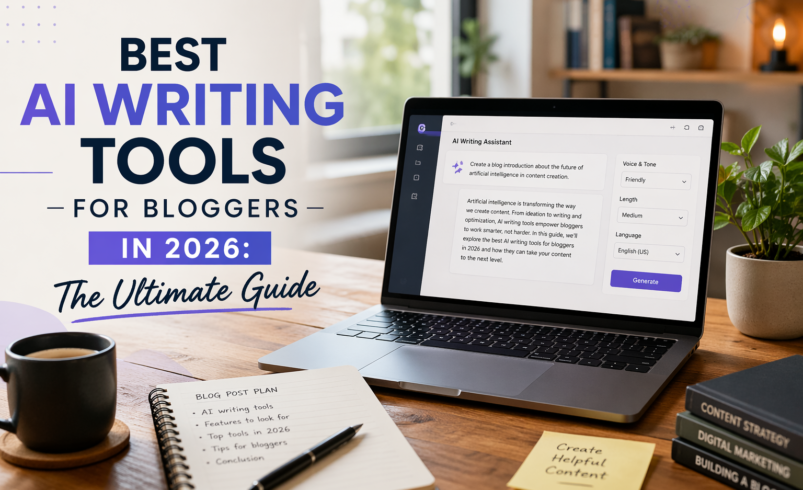
That’s exactly where the best AI writing tools for bloggers in 2026 come in.
Whether you’re a solo blogger trying to publish three posts a week, a content marketer managing multiple brand blogs, or a digital agency scaling output for dozens of clients — AI writing software has become less of a luxury and more of a competitive necessity.
In this guide, we cover everything you need to know: what separates great AI tools from mediocre ones, detailed reviews of the top platforms, a side-by-side comparison table, and practical advice on choosing the right tool for your specific goals.
📌 Also read: [How to Start a Blog in 2026 – Beginner’s Complete Guide]
What to Look for in AI Writing Tools
Before diving into the list, it’s important to understand what actually makes an AI writing tool worth your money. Not all platforms are created equal, and the wrong choice can slow you down rather than speed you up.
1. SEO Capabilities
A great AI writing tool doesn’t just generate content — it generates rankable content.
Look for features like built-in keyword research, on-page SEO scoring, NLP suggestions, and SERP analysis. Tools that integrate with platforms like Surfer SEO or Semrush give you a significant edge.
2. Content Quality and Originality
AI content has come a long way, but quality still varies dramatically between platforms.
The best tools produce human-like, coherent, factually grounded text that doesn’t read like it was generated by a robot. Always check if the platform has plagiarism detection or originality scoring built in.
3. Ease of Use
You shouldn’t need a degree in prompt engineering to get a decent blog post out of an AI tool.
Look for clean interfaces, intuitive workflows, and templates tailored specifically to blog writing — introductions, listicles, how-to guides, product reviews, and more.
4. Pricing and Value
AI tools range from completely free to $100+/month.
Consider your publishing frequency, team size, and whether you need advanced features like brand voice customization or API access. Always compare cost-per-word or cost-per-article when evaluating value.
5. Integrations
The best tools fit into your existing workflow.
Top integrations to look for include WordPress, Google Docs, Shopify, HubSpot, Grammarly, and Chrome extensions that let you write anywhere.
Top AI Writing Tools for Bloggers in 2026
Here are the top AI tools for blog writing and SEO optimization — thoroughly reviewed and ranked for real-world blogger use cases.
1. Jasper AI

Overview
Jasper remains one of the most recognized names in AI content creation. Built specifically for marketers and content creators, it has evolved significantly with improved long-form coherence and deeper SEO integrations.
Key Features
- Boss Mode for long-form blog writing (2,000+ words)
- Surfer SEO integration for real-time optimization
- 50+ content templates including blog posts, outlines, and intros
- Brand voice training across multiple accounts
- Plagiarism checker powered by Copyscape
Pros
- Exceptional long-form output quality
- Strong template library for bloggers
- Reliable brand voice consistency
Cons
- Higher price point than competitors
- Occasional factual inaccuracies require human review
Pricing
- Creator Plan: ~$49/month (1 seat)
- Teams Plan: ~$125/month (3 seats)
Best For
Professional bloggers and content marketing teams who need high-volume, high-quality output with SEO baked in.
2. Writesonic
Overview
Writesonic has positioned itself as one of the most affordable AI writing software for bloggers without compromising on feature depth. Its Chatsonic feature adds real-time web search capabilities to the writing workflow.
Key Features
- AI Article Writer 6.0 for one-click long-form articles
- Chatsonic (ChatGPT alternative with live web access)
- Factual content mode using real-time data
- SEO meta tag generator
- Built-in Surfer SEO integration
Pros
- Excellent value for money
- Real-time web data reduces factual errors
- Fast article generation
Cons
- Output can feel formulaic for niche topics
- Advanced features locked behind higher tiers
Pricing
- Free Plan: 25 credits/month
- Individual Plan: ~$20/month
- Standard Plan: ~$99/month
Best For
Budget-conscious bloggers and freelance writers who want speed and SEO support without a large monthly bill.
3. Copy.ai
Overview
Copy.ai has matured from a short-form copy tool into a fully capable long-form content platform. Its Workflows feature is particularly powerful for bloggers who publish at scale.
Key Features
- Automated Blog Post Workflow (brief → outline → draft in minutes)
- 90+ writing templates
- Infobase for brand and product knowledge storage
- Multi-language support (25+ languages)
- Team collaboration tools
Pros
- Streamlined workflow automation
- Clean and beginner-friendly UI
- Solid free plan
Cons
- Less sophisticated SEO features than Jasper or Writesonic
- Customization options are limited on lower plans
Pricing
- Free Plan: Available (limited)
- Pro Plan: ~$49/month
- Team Plan: ~$249/month
Best For
Bloggers who want a reliable, easy-to-use tool for generating drafts quickly with minimal friction.
4. Surfer SEO + AI Editor
Overview
Surfer SEO is primarily known as an on-page SEO tool, but its integrated AI editor has made it a powerhouse for bloggers who want content that’s engineered to rank from the first draft.
Key Features
- Content Editor with real-time NLP keyword suggestions
- SERP Analyzer to reverse-engineer top-ranking pages
- AI Outline Generator based on top competitors
- Auto-Optimize to instantly boost content score
- Internal linking suggestions
Pros
- Unmatched SEO depth
- Data-driven content recommendations
- Excellent for competitive niches
Cons
- Learning curve for SEO beginners
- AI writing quality alone is secondary to SEO features
Pricing
- Essential Plan: ~$89/month
- Scale Plan: ~$129/month
Best For
SEO-focused bloggers and agencies targeting competitive keywords and aiming for page-one rankings.
5. Notion AI

Overview
If you already use Notion for planning and note-taking, Notion AI is a natural addition. It brings AI writing assistance directly into your content planning and drafting environment.
Key Features
- In-document AI writing, editing, and summarizing
- Auto-fill databases with AI-generated content
- Tone and length adjustment tools
- Blog draft generation from bullet-point notes
- Seamless workspace integration
Pros
- Zero context-switching — write and plan in one place
- Excellent for content calendars
- Very affordable add-on
Cons
- Not a standalone writing tool
- Limited SEO features
Pricing
- Add-on to existing Notion plans: ~$10/month per member
Best For
Bloggers who use Notion as their content hub and want AI assistance without switching tools.
6. Frase.io
Overview
Frase is one of the most well-rounded AI content writing tools for bloggers that blends research, outlining, and writing into a single workflow. It’s especially powerful for research-heavy niches.
Key Features
- AI-powered SERP research for any keyword
- Answer engine for finding top-asked questions
- Content brief generator
- Built-in AI writer with factual sourcing
- Content scoring against competitors
Pros
- Best-in-class content research
- Reduces research time dramatically
- Good for evergreen and authority content
Cons
- AI writing quality can be inconsistent
- Pricing can add up for high-volume users
Pricing
- Solo Plan: ~$15/month (4 articles)
- Basic Plan: ~$45/month
- Team Plan: ~$115/month
Best For
Bloggers in research-heavy niches (health, finance, tech) who want content grounded in real data.
7. Rytr
Overview
Rytr is one of the most affordable AI writing software options for bloggers in 2026, offering surprisingly capable output at a very low price point.
Key Features
- 40+ use cases including blog sections and ideas
- Tone customization (20+ tones)
- Built-in plagiarism checker
- Chrome extension for writing anywhere
- SEO analyzer tool
Pros
- Very affordable (free plan available)
- Fast and simple to use
- Good for short-to-medium blog content
Cons
- Struggles with highly technical or nuanced topics
- Long-form quality not on par with Jasper or Writesonic
Pricing
- Free Plan: 10,000 characters/month
- Saver Plan: ~$9/month
- Unlimited Plan: ~$29/month
Best For
New bloggers, hobbyists, or side-project writers who want AI assistance on a tight budget.
8. GrowthBar
Overview
GrowthBar is built specifically with bloggers and content marketers in mind, combining SEO research tools with an AI writer in a single, streamlined dashboard.
Key Features
- One-click blog post generation with SEO structure
- Keyword research and rank tracking
- Competitor content analysis
- AI paragraph rewriter and expander
- WordPress integration
Pros
- Purpose-built for bloggers
- Clean all-in-one dashboard
- Strong keyword and rank tracking
Cons
- Less customization than Jasper or Surfer
- Fewer integrations with third-party tools
Pricing
- Standard Plan: ~$48/month
- Pro Plan: ~$99/month
- Agency Plan: ~$199/month
Best For
Growth-focused bloggers who want SEO research and AI writing combined in one tool without juggling multiple platforms.
AI Writing Tools Comparison Table
Tool | Starting Price | Standout Feature | Best For |
Jasper AI | $49/month | Long-form + brand voice | Pro bloggers & agencies |
Writesonic | $20/month | Real-time web data via Chatsonic | Budget-conscious bloggers |
Copy.ai | Free / $49/month | Workflow automation | High-volume content teams |
Surfer SEO | $89/month | Real-time NLP SEO scoring | SEO-first content strategy |
Notion AI | $10/month add-on | In-workspace AI drafting | Notion-based content planners |
Frase.io | $15/month | SERP research + content briefs | Research-heavy niche bloggers |
Rytr | Free / $9/month | Ultra-affordable writing assist | Beginners & hobby bloggers |
GrowthBar | $48/month | All-in-one SEO + AI writing | Growth-focused bloggers |
How to Choose the Right AI Writing Tool for Your Blog
With so many options on the market, choosing the right platform comes down to three core factors.
Your Budget
If you’re just starting out, Rytr or Writesonic’s free plan give you more than enough to test the waters.
For serious bloggers ready to invest, Jasper or Surfer SEO offer the best return when ranking and brand consistency are priorities.
Your Goals
- Publishing high-volume content fast? → ai or Writesonic
- Targeting competitive SEO keywords? → Surfer SEO or io
- Building a brand with consistent tone? → Jasper AI
- Keeping everything in one workspace? → Notion AI or GrowthBar
Your Experience Level
Beginners should start with tools that have guided workflows and templates — Copy.ai, Rytr, and GrowthBar are all excellent starting points.
Advanced bloggers and SEO professionals will get more from Surfer SEO, Frase, or Jasper’s more technical capabilities.
📌 Internal link suggestion: [How to Write SEO-Optimized Blog Posts That Rank in 2026]
SEO Benefits of Using AI Writing Tools
The right AI writing tool doesn’t just save time — it actively improves your chances of ranking on Google.
1. Smarter Keyword Optimization
Tools like Surfer SEO and Frase analyze hundreds of top-ranking pages to tell you exactly which keywords, questions, and semantic phrases to include. This goes far beyond simple keyword stuffing — it’s NLP-driven optimization that mirrors how Google understands content.
2. Faster Content Scaling
Consistency is one of the most underrated SEO factors. Publishing two high-quality articles a week consistently beats publishing one article every three weeks.
AI tools make it realistic to maintain publishing frequency without burning out, giving your blog the content velocity it needs to grow domain authority over time.
3. SERP and Featured Snippet Advantages
Many AI tools are specifically trained to structure content in ways that earn featured snippets — the coveted “position zero” results at the top of Google’s search pages.
Using question-based subheadings, concise answer paragraphs, and structured lists increases your chances of capturing these high-visibility placements.
Limitations of AI Writing Tools (Be Aware)
No tool is perfect. Here are the honest limitations you should keep in mind.
Originality and Factual Accuracy
AI models are trained on existing data, which means they can occasionally produce generic or even inaccurate content — especially for rapidly changing topics like news, finance, or technology.
Always fact-check figures, statistics, and claims before publishing. A credible blog is built on trust, and one factual error can damage that.
The Human Touch Still Matters
AI can draft — but it can’t replace your unique perspective, personal experience, or authentic storytelling.
The most successful bloggers in 2026 use AI as a first-draft engine, then layer in their own voice, insights, and examples. Think of it as a highly skilled ghostwriter who needs your direction, not a replacement for your expertise.
SEO Over-Optimization Risk
Some AI tools, when set on aggressive SEO mode, can produce content that feels stuffed or unnatural. Always read your drafts aloud — if it sounds robotic, it’ll read robotic.
📌 Internal link suggestion: [Common AI Content Mistakes Bloggers Make (And How to Fix Them)]
Conclusion: Find Your AI Writing Edge in 2026
The blogging world has never been more competitive — but it’s also never offered more powerful tools to help you succeed.
The best AI writing tools for bloggers in 2026 aren’t about replacing your creativity. They’re about amplifying it. From researching keywords and building outlines to drafting full articles and optimizing for Google, these platforms handle the heavy lifting so you can focus on what you do best: creating content your audience genuinely loves.
Whether you’re a budget blogger eyeing Rytr, an SEO strategist leaning on Surfer SEO, or a content team scaling with Jasper, there’s a perfect tool for your workflow.
Ready to level up your blog? Pick one tool from this list, start a free trial, and publish your next article twice as fast. Your future readers — and your Google rankings — will thank you.
📝 Found this guide helpful? Share it with a fellow blogger and bookmark it for your next content planning session.