







Introduction
You don’t need a gym membership, dumbbells, or expensive equipment to get fit. The best beginner-friendly home workout ideas without equipment are already available to you — right now, in your living room, with nothing but your own bodyweight and a bit of floor space.
Whether your gym is too expensive, your schedule is too packed, or you’re simply not ready to walk into a room full of experienced lifters, home workouts remove every barrier between you and getting started. No commute. No judgment. No cost.
This guide covers 15 beginner-friendly exercises, 5 ready-to-use workout plans for different goals, and everything you need to know about building a sustainable home fitness routine — including how to progress without plateauing and how to stay consistent when motivation dips.
If you’re wondering how to start exercising at home for beginners, this is where you start.
People find waiting more tolerable when they can see the work being done on their behalf
“Labor Illusion” insight
Table of Contents
- Benefits of No-Equipment Home Workouts
- Exercise Quick-Reference Table
- The 15 Best Beginner Home Exercises
- 5 Ready-to-Use Workout Plans
- Low-Impact vs High-Intensity Comparison
- Beginner vs Intermediate Progressions
- Common Beginner Mistakes
- How to Stay Consistent
- Home Workouts and Weight Loss
- FAQ
- Conclusion
1. Benefits of No-Equipment Home Workouts
Before getting into the exercises, it’s worth understanding why home workouts are not a lesser version of gym training — they’re a genuinely effective alternative, especially for beginners.
- Zero cost: no membership, no commute, no equipment to buy
- Available at any time: 6 AM, 8 PM, or a spare 10 minutes at lunch
- Beginner comfort: no performance anxiety, no comparison to others
- Effective fat loss: bodyweight cardio and circuits burn significant calories
- Real strength gains: squats, push-ups, and planks build functional muscle without weights
- Flexibility: easily modified for any fitness level or physical limitation
- Mental health benefits: exercise reduces cortisol and increases endorphins, regardless of location
The best workout is the one you actually do. Home workouts remove every excuse between intention and action.
2. Exercise Quick-Reference: 15 Beginner Home Exercises
Here’s a full overview before the detailed breakdowns. Use this to plan your sessions.
*Calorie burn per 10 minutes varies by body weight and intensity.
|
Exercise |
Difficulty |
Main Muscle |
Best For |
Calorie Burn* |
|
Squats |
Beginner |
Quads, glutes, core |
Strength + fat loss |
Medium |
|
Push-ups (modified) |
Beginner |
Chest, shoulders, arms |
Upper body, core |
Medium |
|
Glute Bridges |
Beginner |
Glutes, hamstrings |
Lower body, posture |
Low-Medium |
|
Lunges |
Beginner |
Quads, glutes |
Leg strength, balance |
Medium |
|
Planks |
Beginner |
Core (full) |
Core stability |
Low |
|
Jumping Jacks |
Beginner |
Full body, cardio |
Warm-up, fat loss |
Medium-High |
|
Mountain Climbers |
Beginner-Inter |
Core, shoulders, cardio |
Fat loss, endurance |
High |
|
High Knees |
Beginner |
Core, hip flexors, cardio |
Cardio, fat loss |
High |
|
Wall Sit |
Beginner |
Quads, glutes |
Endurance, leg strength |
Low |
|
Crunches |
Beginner |
Abs (rectus abdominis) |
Core, abs |
Low |
|
Bird-Dog |
Beginner |
Core, lower back, glutes |
Balance, posture |
Low |
|
Chair Dips |
Beginner |
Triceps, shoulders |
Upper body tone |
Low-Medium |
|
Step-ups |
Beginner |
Quads, glutes, cardio |
Full body, fat loss |
Medium-High |
|
Calf Raises |
Beginner |
Calves |
Lower leg tone |
Low |
|
Yoga Stretches |
Beginner |
Full body flexibility |
Recovery, mobility |
Low |
3. The 15 Best Beginner Home Exercises
🦵 Squats
The squat is the single most effective lower-body exercise for beginners. It works the quads, glutes, hamstrings, and core simultaneously — making it the highest-value movement per unit of effort in any no-equipment beginner workout plan.
How to do it
- Stand with feet shoulder-width apart, toes slightly turned out
- Push your hips back and bend your knees — as if sitting into a chair
- Keep your chest up and weight through your heels
- Lower until thighs are roughly parallel to the floor, then push back up
Beginner version: Start with chair-assisted squats — lower yourself toward a chair and stand back up before fully sitting. This teaches the movement pattern with confidence.
Common mistake
Letting knees cave inward or lifting heels — keep knees tracking over toes, heels flat throughout.
🧱 Wall Sit
The wall sit builds quad endurance and lower-body strength with zero impact — perfect for anyone with knee sensitivity or joint concerns. It also teaches muscular endurance, which translates directly to better squats and lunges.
How to do it
- Stand with your back flat against a wall
- Slide down until thighs are parallel to the floor — 90° knee angle
- Hold for as long as you can (aim for 20–30 seconds to start)
Beginners: start at a shallower angle (less than 90°) and build depth over time.
💪 Push-Ups (Modified Versions)
Push-ups are the most complete upper-body bodyweight exercise — working chest, shoulders, triceps, and core. The key for beginners is starting with a variation that allows clean form rather than struggling with standard push-ups.
Progression path
- Wall push-ups (complete beginner) → Incline push-ups (hands on sofa) → Knee push-ups → Full push-ups
- Focus on keeping hips level — a sagging back or raised hips means the difficulty is beyond current strength
- Even 5 quality wall push-ups are more valuable than 20 sloppy floor ones
For full push-up form: body in straight line from head to heels, lower chest to 2cm from floor, elbows at 45° angle to body (not flared wide).
🍑 Glute Bridges
Glute bridges are one of the most underrated beginner exercises — directly activating the glutes (the largest muscle group in the body), strengthening the lower back, and improving hip mobility and posture.
How to do it
- Lie on your back with knees bent, feet flat on the floor hip-width apart
- Press through your heels and squeeze your glutes to lift your hips toward the ceiling
- Hold at the top for 1–2 seconds, then lower with control
- Keep your core engaged throughout — avoid arching your lower back
Particularly valuable for people who sit for long hours — activates the glutes that desk work suppresses.
🚶 Lunges
Lunges train each leg independently, which improves balance, corrects muscle imbalances, and activates the glutes and quads effectively. They’re also one of the best at home exercises for weight loss beginners because they work large muscle groups and elevate heart rate.
How to do it
- Stand tall, then step forward with one foot — lower your back knee toward the floor
- Front knee stays above your ankle, not caving inward
- Push back to standing, then alternate legs
Beginner version: stationary lunge — step forward and stay there for 8 reps per side before switching. This builds confidence before adding the walking pattern.
⭐ Jumping Jacks
Jumping jacks are the most accessible full-body cardio exercise for beginners — requiring no space, no skill, and no equipment. They warm up every major joint and elevate heart rate within 60 seconds.
- Targets: shoulders, inner and outer thighs, calves, core
- Start at 30 seconds and build toward 60–90 seconds
- Low-impact version: step side-to-side instead of jumping — same arm movement, no impact
⏱️ Planks
The plank is the most efficient core exercise in existence — working the entire anterior and posterior core simultaneously without any movement. Strong core = better posture, less back pain, and improved performance in every other exercise.
How to do it
- Forearms on the floor, elbows below shoulders
- Body in a straight line from head to heels — don’t let hips sag or pike
- Hold as long as form is perfect (stop at form breakdown, not exhaustion)
- Build from 15 seconds to 60 seconds over 4–6 weeks
Beginner version: knee plank — same upper body position but knees on the floor. Reduces the load by approximately 50% while building the core engagement pattern.
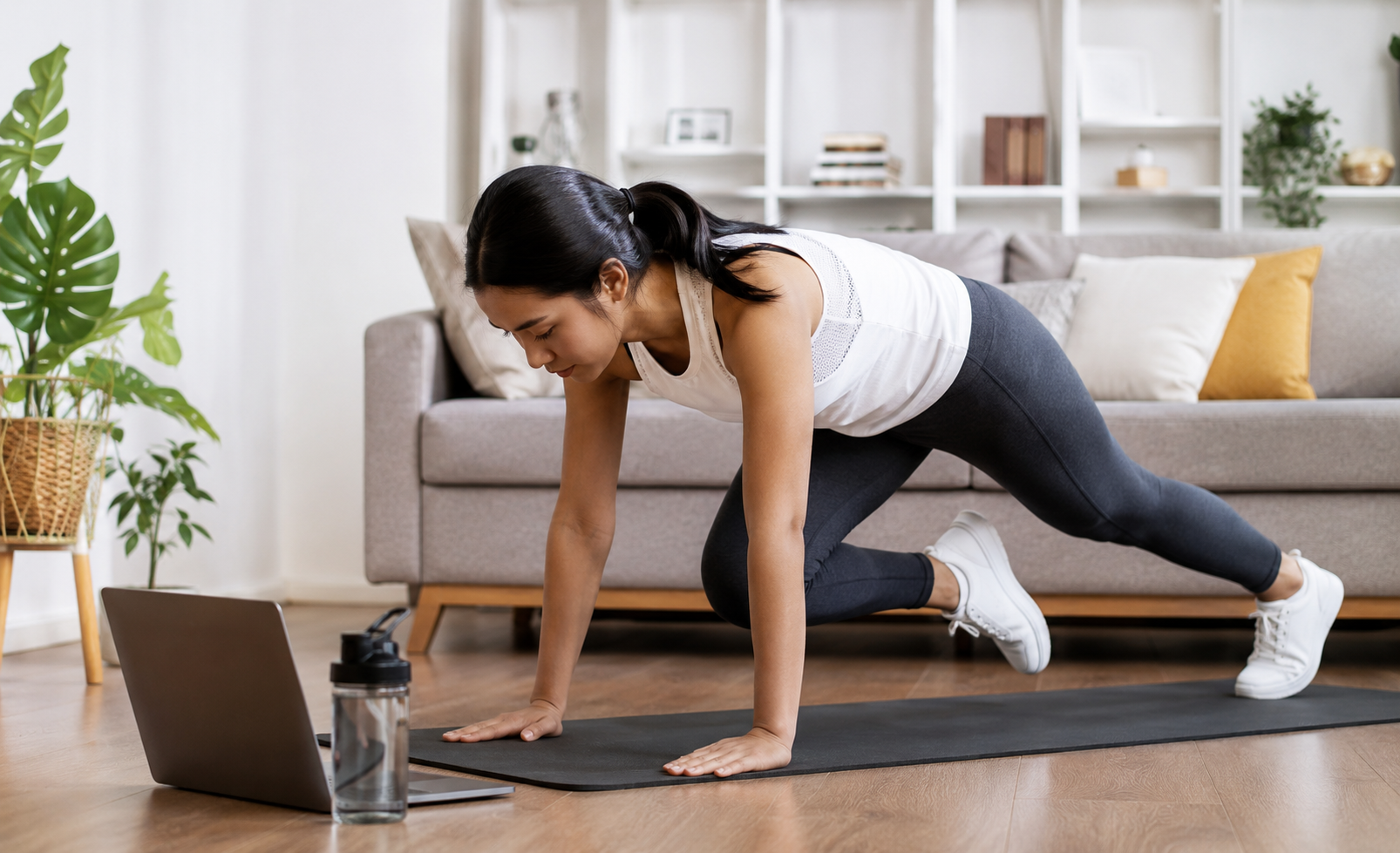
🏔️ Mountain Climbers
Mountain climbers combine core strengthening and cardio in one movement — making them one of the highest-calorie-burning exercises in a beginner full body workout at home without gym equipment.
- Start in a push-up position, hands below shoulders
- Drive one knee toward your chest, then quickly switch — alternating legs continuously
- Keep hips level — don’t bounce them up and down
- Beginner: slow and controlled (step, don’t jump); intermediate: fast and continuous
🏃 High Knees
High knees are a running-in-place exercise that delivers excellent cardiovascular conditioning and burns calories efficiently — without needing outdoor space or weather cooperation.
- Drive your knees up to hip height alternately while pumping opposite arms
- Land lightly on the balls of your feet to reduce impact
- Start with 20–30 seconds, build toward 60 seconds
- Low-impact version: march in place with exaggerated knee lifts
🎯 Crunches
Crunches directly target the rectus abdominis and are effective when done with proper technique — short, controlled movement rather than pulling the neck or using momentum.
- Lie on your back, knees bent, hands behind head (lightly — don’t pull your neck)
- Curl your shoulder blades off the floor, hold 1 second at the top, lower slowly
- Exhale as you crunch up — this engages the abs more effectively
Quality over quantity: 12 slow, controlled crunches outperform 30 fast, sloppy ones for muscle activation.
🐦 Bird-Dog
The bird-dog is one of the most functional core exercises for beginners — training stability, balance, and lower-back health simultaneously. It’s particularly valuable for anyone with lower back discomfort.
- Start on all fours — wrists below shoulders, knees below hips
- Slowly extend your right arm forward and left leg back — keep back flat, hips level
- Hold 3–5 seconds, lower with control, then switch sides
- The movement should feel slow and deliberate — this isn’t a speed exercise
🪑 Chair Dips
Chair dips target the triceps (backs of arms) and anterior shoulders — a muscle group that’s difficult to work without weights and often neglected in beginner routines.
- Sit on the edge of a sturdy chair, hands gripping the seat beside your hips
- Slide your hips off the seat, lower your body by bending elbows to 90°
- Push back up to the starting position
Ensure the chair is stable and against a wall before starting.
🏗️ Step-Ups (Using Stairs)
If you have a staircase, you have one of the best cardio and lower-body training tools available. Step-ups simultaneously elevate heart rate, work the quads and glutes, and improve coordination.
- Step up with one foot, bring the other up to meet it, step back down, alternate legs
- Start with the lowest step — increase height as fitness improves
- Add speed gradually to convert this into a calorie-burning cardio exercise
🦷 Standing Calf Raises
Calf raises are simple, require no space, and can be done anywhere — including while waiting for the kettle. They strengthen the calves and improve ankle stability.
- Stand near a wall for balance, rise onto the balls of your feet, lower slowly
- Single-leg version significantly increases the challenge
- 3 sets of 15–20 reps daily builds noticeable lower-leg definition over 4–6 weeks
🧘 Yoga Stretches
Yoga stretches are not just recovery — they improve range of motion, reduce injury risk, lower cortisol, and enhance the quality of every strength movement. For beginners who’ve been sedentary, flexibility work often produces the most immediate quality-of-life improvement.
- Child’s pose: hip flexors, lower back
- Cat-cow: spine mobility, lower back relief
- Downward dog: hamstrings, calves, shoulders
- Seated hamstring stretch: posterior chain mobility
Include 5–10 minutes of yoga stretches at the end of every session — this is recovery work that directly improves next-session performance.
4. Ready-to-Use Beginner Workout Plans
🕐 10-Minute Beginner Workout (Daily Starter)
Perfect for building the habit. Do this every day for 2 weeks before progressing.
- Jumping Jacks — 30 seconds
- Squats — 10 reps
- Knee Push-ups — 8 reps
- Glute Bridges — 12 reps
- Plank — 20 seconds
- Yoga cool-down — 2 minutes
Rest: 30 seconds between exercises. Repeat the circuit twice if energy allows.
🔥 20-Minute Fat Loss Routine
Circuit format — minimal rest, maximum calorie burn. Do 3 rounds.
- High Knees — 40 seconds
- Squats — 15 reps
- Mountain Climbers — 30 seconds
- Lunges — 10 reps per leg
- Jumping Jacks — 40 seconds
- Plank — 30 seconds
Rest 60 seconds between rounds. Aim 3x per week on alternating days.
🌿 Low-Impact Beginner Routine (Joint-Friendly)
For beginners with joint sensitivity, injury recovery, or those returning after a long break.
- Wall sit — 20 seconds x 3
- Glute Bridges — 12 reps x 3
- Bird-Dog — 8 reps per side x 3
- Calf Raises — 15 reps x 3
- Knee Plank — 20 seconds x 3
- Yoga stretches — 10 minutes
No jumping, no impact. Daily or every other day.
💪 Full Body Home Workout Plan (3 Days Per Week)
Monday / Wednesday / Friday — rest or yoga on off-days.
- Warm-up: Jumping Jacks 60 sec + High Knees 30 sec
- Squats — 3 sets of 12
- Push-ups (any variation) — 3 sets of 8–10
- Lunges — 3 sets of 10 per leg
- Glute Bridges — 3 sets of 12
- Mountain Climbers — 3 sets of 30 seconds
- Plank — 3 x 30 seconds
- Crunches — 3 sets of 15
- Cool-down: Yoga stretches — 5–8 minutes
🌅 Morning Workout Routine for Beginners (15 Minutes)
Before breakfast — elevates metabolism and sets a productive tone for the day.
- Cat-cow stretches — 60 seconds
- Squats — 12 reps
- Glute Bridges — 12 reps
- Push-ups — 8 reps
- High Knees — 30 seconds
- Plank — 20 seconds
- Child’s pose + downward dog — 2 minutes
No equipment, completes before coffee. Build to 20 minutes within 4 weeks.
5. Low-Impact vs High-Intensity Comparison
|
Factor |
Low-Impact |
High-Intensity (HIIT) |
|
Examples |
Wall sit, calf raises, bird-dog, yoga |
Mountain climbers, high knees, jumping jacks |
|
Joint stress |
Minimal — suitable for joint issues |
Moderate — not ideal for injuries |
|
Calorie burn |
Lower per minute |
Higher per minute |
|
Recovery needed |
Minimal — can do daily |
48 hrs between sessions recommended |
|
Best for |
Seniors, beginners, recovery days |
Fat loss, cardiovascular fitness |
|
Heart rate |
50–60% max |
75–90% max |
Cardio vs Strength Bodyweight Exercises
|
Category |
Cardio Bodyweight |
Strength Bodyweight |
Combine for |
|
Goal |
Fat burn, endurance |
Muscle tone, strength |
Best overall results |
|
Examples |
Jumping jacks, high knees, step-ups |
Squats, push-ups, lunges |
Circuit training |
|
Duration |
10–30 min continuous |
3 sets of 8–15 reps |
20–40 min circuits |
|
Rest periods |
30–60 sec |
60–90 sec between sets |
45 sec between exercises |
|
Progress |
Increase speed/duration |
Increase reps/harder variation |
Add HIIT bursts |
6. Beginner to Intermediate Progressions
Every exercise has a harder version. Use this table to progress when the current difficulty feels easy for 3 consecutive sessions:
|
Exercise |
Beginner Version |
Intermediate Version |
Advanced Version |
|
Push-up |
Wall push-up / knee push-up |
Standard push-up |
Wide/narrow grip, decline |
|
Squat |
Chair-assisted squat |
Bodyweight squat |
Jump squat, single-leg |
|
Plank |
Knee plank (20 sec) |
Full plank (30–45 sec) |
Side plank, plank with reach |
|
Lunge |
Stationary lunge |
Walking lunge |
Reverse lunge with knee raise |
|
Crunch |
Heel touch crunch |
Standard crunch |
Bicycle crunch, V-sit |
Progress when form is perfect — not when you’re just surviving the reps. Quality always before quantity or difficulty.
7. Common Beginner Mistakes
1. Skipping the Warm-Up
Cold muscles are significantly more injury-prone. 3–5 minutes of gentle movement (jumping jacks, marching in place, arm circles) before every session is non-negotiable. It also improves performance in the workout itself.
2. Overtraining in Week One
New exercisers frequently go all-out in the first week and can’t move in week two. Start with 3 days per week, not 7. Muscle soreness after new exercise (DOMS) peaks 24–48 hours after the session and is normal — but is a signal to rest the worked muscles before training them again.
3. Poor Form for More Reps
10 perfect squats are more effective and far safer than 20 sloppy ones. Form failures become habit. If your form breaks down before the target rep count, stop, rest, and continue — or reduce reps until strength catches up.
4. Unrealistic Expectations
Visible body composition changes typically take 6–8 weeks of consistent effort with a calorie-aware diet. Energy levels, sleep quality, and mood improve within the first 2 weeks. Set goals around consistency and performance (more reps, longer plank) rather than appearance outcomes — they’re more motivating and more in your control.
5. Ignoring Recovery
Muscle is built during rest, not during exercise. Sleep (7–9 hours), adequate protein (1.4–1.6g per kg of body weight), and rest days are as important as the workouts themselves for progressive improvement.
8. How to Stay Consistent
- Schedule workouts like appointments — same time, same days, in your calendar
- Prepare your workout space the night before — reduce friction to start
- Start smaller than feels necessary — a 10-minute session beats a skipped 45-minute one
- Track progress: log reps, hold times, or how you feel — improvement is motivating
- Use habit stacking: pair workout with an existing routine (after waking, before shower)
- Find accountability: a workout buddy, an app, or even posting on social media
- Celebrate consistency, not perfection — 3 sessions per week for 8 weeks beats 7 sessions per week for 10 days
9. Home Workouts and Weight Loss
A full body no equipment workout for weight loss works through two mechanisms: calories burned during exercise and elevated resting metabolic rate from increased muscle tissue.
A 20-minute home circuit burns approximately 150–300 calories depending on intensity and body weight. Over a week of 4 sessions, that’s 600–1,200 calories from exercise alone — meaningful, but not the full story.
The Honest Fat Loss Formula
- Consistent exercise creates a calorie deficit and preserves/builds muscle
- Muscle tissue burns more calories at rest than fat tissue — improving baseline metabolism
- Results are amplified significantly by diet: exercise alone typically produces 0.5–1kg fat loss per month; exercise plus a modest calorie reduction doubles or triples this
- Consistency over intensity: 3 moderate sessions per week sustained for 6 months outperforms 6 intense sessions per week sustained for 3 weeks
Realistic expectation: with consistent 3x weekly training and diet awareness, most beginners lose 0.5–1kg per week during the first 8–12 weeks.
10. FAQ — People Also Ask
Can beginners get fit without equipment?
Yes — bodyweight training is genuinely effective for improving fitness, building functional strength, and losing fat. The limitation is at advanced levels where progressive overload becomes harder without added resistance. For beginner and intermediate fitness goals — which cover the first 6–12 months of training — no equipment is needed.
What is the best home workout for beginners?
The best beginner home workout combines lower-body (squats, lunges, glute bridges), upper-body (push-up variations), core (plank, bird-dog), and cardio (jumping jacks, high knees). A 20-minute circuit 3x per week is the most sustainable starting structure for most beginners.
How long should beginners work out at home?
10–20 minutes is sufficient to begin, 3 days per week. Duration matters less than consistency in the early stages. Adding 5 minutes per session every 2 weeks is a sustainable progression that prevents the overtraining burnout that ends most beginner programmes.
Can I lose weight with no-equipment workouts?
Yes — particularly when combined with a calorie-aware diet. Bodyweight cardio and circuit training burn significant calories and build muscle tissue that elevates resting metabolism. Most beginners see meaningful fat loss within 6–8 weeks of 3x weekly sessions plus dietary awareness.
Is a 10-minute home workout effective?
Yes for beginners — a 10-minute circuit performed consistently every day builds exercise habit, improves cardiovascular fitness, and activates major muscle groups. The evidence on ‘exercise snacks’ (short bouts of activity throughout the day) shows measurable metabolic benefits. 10 minutes done daily is more effective than 45 minutes done twice a month.
How often should beginners exercise?
3 days per week with rest or light activity (walking, yoga) on other days is the evidence-backed starting point. This allows adequate muscle recovery while building the habit. After 4–6 weeks of consistent 3x training, progressing to 4 days per week is appropriate.
Can bodyweight workouts build muscle?
Yes — particularly for beginners who haven’t trained before. The progressive overload principle applies to bodyweight training: moving from wall push-ups to standard push-ups to decline push-ups creates increasing muscular demand. For advanced muscle building, added resistance eventually becomes necessary — but this is irrelevant for the first 6–12 months of training.
11. Conclusion
The gym doesn’t have a monopoly on fitness. The best beginner-friendly home workout ideas without equipment are accessible right now — no cost, no commute, no waiting for equipment.
Start with the 10-minute daily routine. Add 5 minutes each week. Progress from wall push-ups to standard push-ups, from chair-assisted squats to jump squats, from a 15-second plank to a 60-second plank. These aren’t small wins — they’re exactly how fitness is built.
The hardest part of any workout programme isn’t the exercises. It’s showing up consistently. Home training removes every logistical barrier to showing up. The rest is just doing the work.
Pick one routine from this guide. Set a time. Show up tomorrow. That’s the entire formula.